Chemical Resistant Coating For Concrete . Novorez® coatings uniquely combine epoxy novolac and polysulfide technology. Great for concrete floors and countertops. Wet Environments & Hygienic Floors Impact Flooring from www.impactfloors.co.uk Floor toppings resistant to high concentration acids and alkalis. Pumacrete ® flooring is available as a urethane mortar floor, or epoxy. Liquid proof (according to the products chemical resistance table) easy application.
What Is Not Conserved In A Chemical Reaction. The mole ratio may be determined by examining the coefficients in front of formulas in a balanced chemical equation. The hydrogen cations and oxygen anions are then free to react with each other, which they do because of their electronegativity differences.
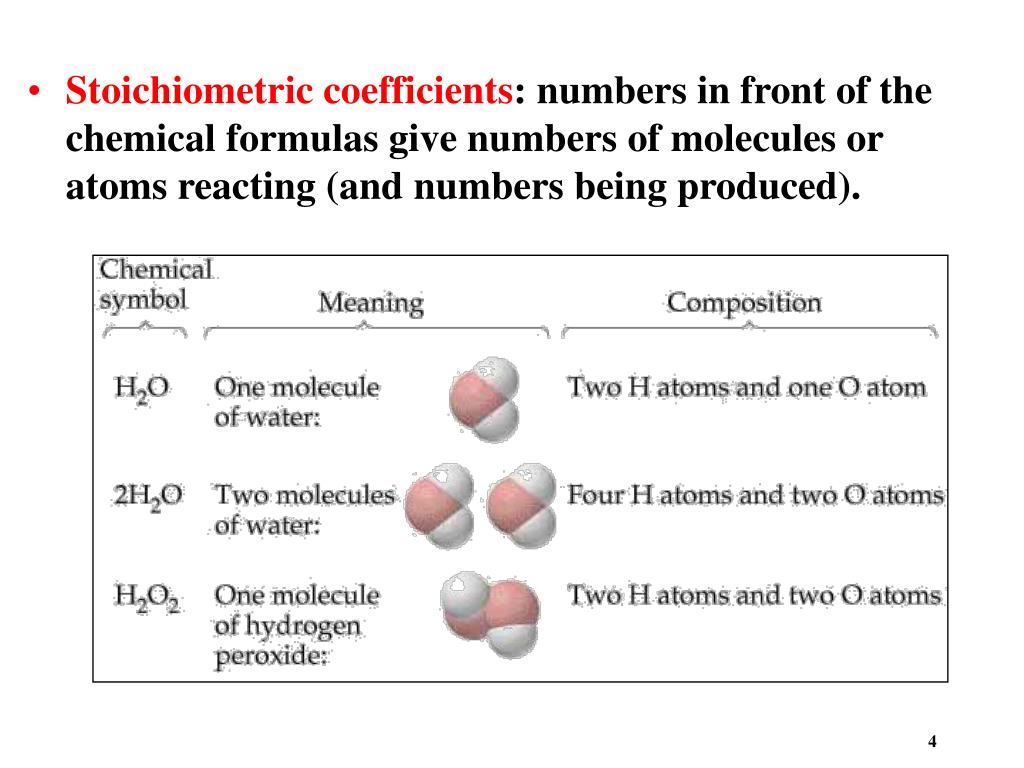
PPT Quantities of Reactants and Products PowerPoint Presentation from www.slideserve.com
The total number of each type of atom is conserved, and thus the mass does not change. In a chemical process, the atoms that make up the original substances are regrouped into different molecules, and these new substances have different properties from those of the reactants. The second reaction is double displacement because both reactants exchange anions in the product.
The Chemical Equilibrium Between S And P Is Determined By The Laws Of Thermodynamics (As Discussed Further In The Next Section Of This Chapter) And Is Represented By The Ratio Of The Forward And Reverse Reaction Rates (S→P And P→S, Respectively).In The Presence Of The Appropriate Enzyme, The Conversion Of S To P Is Accelerated, But The Equilibrium Between S And P Is.
In a chemical process, the atoms that make up the original substances are regrouped into different molecules, and these new substances have different properties from those of the reactants. Learn about the rate of reaction and factors affecting reaction rate here. The mole ratio may be determined by examining the coefficients in front of formulas in a balanced chemical equation.
A Mole Ratio Is The Ratio Between The Amounts In Moles Of Any Two Compounds Involved In A Chemical Reaction.
The second reaction is double displacement because both reactants exchange anions in the product. Lavoisier’s experiments marked the first time someone clearly tested this idea of the conservation of matter by measuring the masses of materials. Combination chemical reactions are the most common chemical reactions.
The Net Reaction Is Highly Exothermic, Meaning A Reaction That Is Accompanied By The Release Of.
Studying an enzyme's kinetics in this way can reveal the catalytic mechanism of this enzyme, its role in metabolism, how its activity is controlled, and how a drug or a modifier. Three treatments, i.e., no fertiliser (control), chemical fertiliser n, p, and k (npk), and organic manure plus chemical fertiliser (npkm), have. Mole ratios are used as conversion factors between products and reactants in many chemistry problems.
A Chemical Reaction Has No Mass, Has No Specific Heat, And Does Not Change Temperature.
The rate of reaction refers to the speed of the conversion of reactants into products in a chemical reaction. Some chemical reactions release energy, others store energy. In this demonstration, the chemical reaction releases heat to the immediate the surroundings.
The Hydrogen Cations And Oxygen Anions Are Then Free To React With Each Other, Which They Do Because Of Their Electronegativity Differences.
A chemical reaction consists of bonds breaking and bonds forming and this is a form of potential energy. The total number of each type of atom is conserved, and thus the mass does not change. In the late 1700s, lavoisier proved through experimentation that the total mass does not change in a chemical reaction, leading him to declare that matter is always conserved in a chemical reaction.


Comments
Post a Comment